Last updated: July 2026 · Reading time: 10 min
Trichloroisocyanuric Acid (TCCA) is the highest-concentration solid chlorine disinfectant in commercial use, delivering 90% available chlorine in a stable, transportable form. This complete product guide covers TCCA specifications, available formats, dosage protocols, packaging options, storage requirements, and global regulatory compliance for industrial and commercial buyers.
1. Product Identification
| Property | Specification |
|---|---|
| Chemical name | Trichloroisocyanuric Acid |
| Common abbreviation | TCCA / Symclosene / TCICA |
| CAS number | 87-90-1 |
| Molecular formula | C₃Cl₃N₃O₃ |
| Molecular weight | 232.41 g/mol |
| EINECS number | 201-782-8 |
| HS code (China export) | 2933.69.2910 |
| UN number | UN 2468, Class 5.1 Oxidizer, PG II |
2. Technical Specification (Standard Industrial Grade)
| Parameter | Standard | Test Method |
|---|---|---|
| Available chlorine content | 90% min | Iodometric titration |
| Appearance | White crystalline powder / granular / tablet | Visual |
| Odor | Characteristic chlorine odor | – |
| Moisture content | 0.5% max | Karl Fischer |
| pH (1% aqueous solution) | 2.7 – 3.3 | pH meter, 25°C |
| Solubility in water (25°C) | 1.2 g / 100 mL | Gravimetric |
| Bulk density (granular) | 0.85 – 0.95 g/cm³ | Tap density |
| Melting / decomposition point | 246 – 254°C (decomposes) | DSC |
| Heavy metals (as Pb) | 10 ppm max | ICP-MS |
| Iron content | 50 ppm max | AAS |
3. Available Product Formats
3.1 Granular TCCA
Free-flowing white granules, 8-30 mesh or 20-60 mesh. Preferred for automatic dosing systems, erosion feeders, and industrial water treatment where a controlled dissolution rate is needed. Dissolves over 30-90 minutes depending on water temperature and circulation.
3.2 Powder TCCA
Fine white powder, typically 100-200 mesh. Used as a raw material for downstream formulation into tablets, effervescent products, cleaning compounds, and blended sanitizers. Also used in textile bleaching where rapid dispersion matters.
3.3 Tablet TCCA
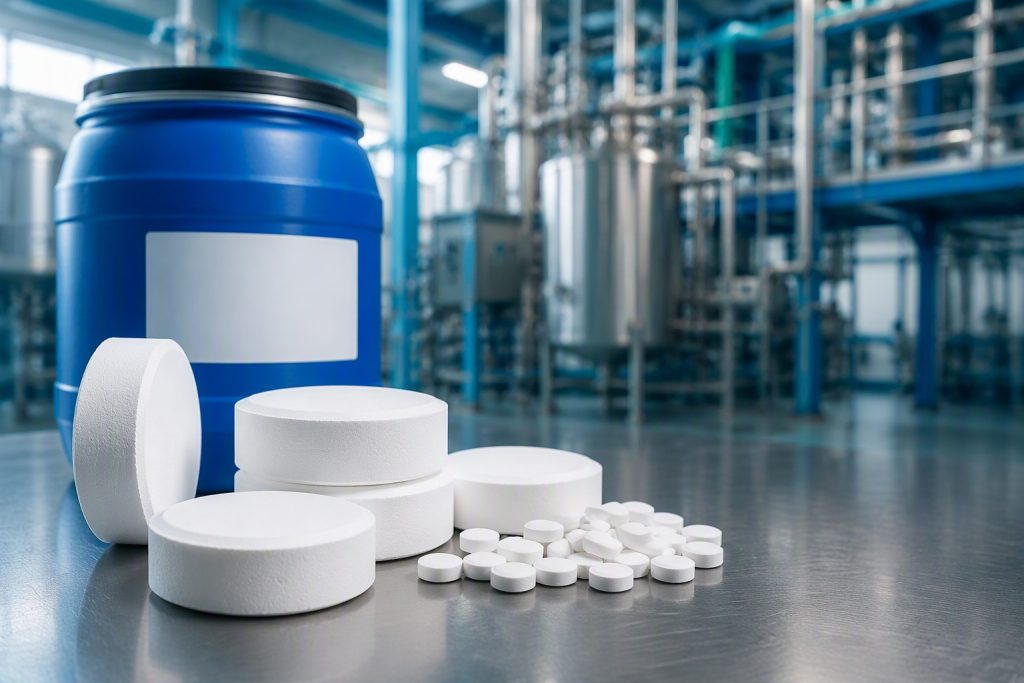
Compressed tablets available in standard sizes. Each format targets a specific dosing scenario:
| Tablet Size | Diameter | Typical Application | Dissolution Time |
|---|---|---|---|
| 1 g | ~13 mm | Drinking water, small containers, emergency purification | 3 – 8 min |
| 3.3 g | ~20 mm | Household water storage, small tanks | 8 – 15 min |
| 20 g | ~38 mm | Spa, small pool, cooling tower dosing | 2 – 4 hours |
| 200 g | ~75 mm | Commercial and residential pool floaters, skimmer baskets | 5 – 7 days |
| Custom (jumbo 500 g) | ~90 mm | Large municipal or industrial systems | 10 – 14 days |
4. Chemistry – How TCCA Works
When TCCA contacts water, it hydrolyzes and progressively releases hypochlorous acid (HOCl), the active biocidal species:
C₃Cl₃N₃O₃ + 3 H₂O → C₃H₃N₃O₃ + 3 HOCl
The reaction produces cyanuric acid (CYA) as a byproduct. CYA is not waste – it acts as a UV stabilizer, binding loosely to free chlorine and shielding it from photodegradation. In outdoor applications this extends chlorine residual life by 8-10 times compared with unstabilized sodium hypochlorite.
Because dissolution is gradual, TCCA behaves as a slow-release chlorine reservoir rather than a shock dose. This makes it the standard choice for continuous maintenance disinfection.
5. Application Areas and Dosage Rates
5.1 Swimming Pool and Spa Disinfection
The dominant global application. TCCA maintains free chlorine at 1-3 ppm with minimal operator intervention.
| Pool Volume | 200 g Tablets per Week | Target Free Cl |
|---|---|---|
| 20 m³ (5,300 gal) | 1 – 2 tablets | 1 – 3 ppm |
| 50 m³ (13,200 gal) | 3 – 4 tablets | 1 – 3 ppm |
| 100 m³ (26,400 gal) | 6 – 8 tablets | 1 – 3 ppm |
| 500 m³ (132,000 gal) | 28 – 36 tablets | 1 – 3 ppm |
Adjust upward in hot weather, heavy bather load, or after rainfall. Keep cyanuric acid below 100 ppm; above that level chlorine effectiveness declines and partial water replacement is required.
5.2 Industrial Cooling Water Systems
TCCA controls biofilm, Legionella, and algal growth in cooling towers and condensers.
- Continuous dosing: 0.5 – 1.0 ppm free residual chlorine
- Shock dosing: 3 – 5 ppm for 2-4 hours, weekly or biweekly
- Monitor ORP at 650-750 mV for automated control
- Compatible with most corrosion inhibitors, but confirm with your water treatment chemist
5.3 Aquaculture and Fish Farming
- Pond preparation (pre-stocking): 10 – 20 ppm, hold 3-5 days, then full water exchange
- Routine prophylaxis: 0.2 – 0.4 ppm every 5-7 days
- Disease outbreak response: 0.5 – 0.8 ppm single dose, reseed probiotics after 48 hours
- Equipment and net sanitization: 500 ppm soak, 30 minutes
Note: for shrimp culture, SDIC is often preferred for its faster dissolution and neutral pH. See our SDIC vs TCCA comparison for selection guidance.
5.4 Drinking Water Treatment
- Municipal supply: 1 – 3 mg/L residual after 30-minute contact time
- Emergency and field purification: one 1 g tablet per 100-200 L of clear water
- WHO guideline limit: 5 mg/L free chlorine maximum
- Always verify local drinking water regulatory approval before use
5.5 Other Industrial Uses
- Textile bleaching: wool shrink-proofing, cotton whitening
- Paper and pulp: slime control in white water systems
- Food processing: CIP sanitation, produce wash (rinse required)
- Agriculture: greenhouse irrigation line sanitation, seed treatment
- Household products: toilet cleaner blocks, hard-surface sanitizer formulations
6. Packaging Options
| Package Type | Net Weight | 20′ FCL Capacity | Best For |
|---|---|---|---|
| HDPE drum | 25 kg / 50 kg | 20 – 22 MT | Bulk industrial supply |
| Plastic bottle (in carton) | 1 kg / 5 kg / 10 kg | 18 – 20 MT | Retail and distributor packs |
| Fiber drum with PE liner | 25 kg / 50 kg | 20 – 22 MT | Cost-sensitive bulk shipments |
| Woven bag with inner liner | 25 kg | 24 – 26 MT | Granular, high-volume industrial |
| Aluminum foil strip | 1 g / 3.3 g tablets | Varies | Emergency kits, travel purification |
Private label, OEM branding, and multi-language labeling are supported. Provide artwork in AI or PDF format with 3 mm bleed.
7. Storage and Handling Requirements
- Temperature: store below 30°C; must never exceed 60°C
- Humidity: keep below 65% relative humidity; TCCA is hygroscopic and hydrolyzes on moisture contact
- Ventilation: well-ventilated warehouse; avoid confined storage without air exchange
- Segregation: minimum 6 m separation from acids, ammonia, ammonium salts, organic solvents, oils, and reducing agents
- Fire classification: NFPA 400 Class 3 oxidizer; sprinkler protection required in most jurisdictions
- Shelf life: 2 years in sealed original packaging under specified conditions
- Container inspection: check monthly for moisture ingress, swelling, or corrosion
Critical warning: never mix TCCA with ammonia, urea, or ammonium-containing compounds. The reaction produces nitrogen trichloride, an explosive and highly toxic gas. Full safety protocols are covered in our chlorine disinfectant safety guide.
8. Safety Classification and PPE
| Hazard Class | GHS Category |
|---|---|
| Oxidizing solid | Category 2 |
| Acute oral toxicity | Category 4 (LD50 rat: 700 – 750 mg/kg) |
| Serious eye damage | Category 1 |
| Skin irritation | Category 2 |
| Specific target organ toxicity (respiratory) | Category 3 |
| Hazardous to aquatic environment (acute) | Category 1 |
Required PPE for handling: chemical splash goggles (ANSI Z87.1), nitrile gloves 8+ mil, N95 or P100 respirator for dust exposure, chemical apron, closed-toe boots, long sleeves. Provide local exhaust ventilation at weighing and mixing stations.
9. Global Regulatory Compliance
| Market | Registration Requirement | Governing Body |
|---|---|---|
| United States | EPA pesticide registration for antimicrobial use | US EPA |
| European Union | BPR Article 95 listing, Product Type 2/5/11/12 | ECHA |
| Australia | APVMA registration for pool and agricultural use | APVMA |
| India | CIB & RC (agriculture) / BIS IS 12928 (retail) | CIB / BIS |
| Brazil | ANVISA sanitizing product registration | ANVISA |
| Middle East (GCC) | GSO conformity certificate, SASO for Saudi Arabia | GSO / SASO |
| China (domestic) | GB/T 22591-2017 national standard | SAMR |
Detailed import procedures for Australia and India are covered in our Asia-Pacific compliance guide.
10. Quality Documentation Provided
- Certificate of Analysis (COA) per production batch
- Safety Data Sheet (SDS) in GHS 16-section format, multiple languages
- Third-party test report (SGS, BV, or TUV on request)
- ISO 9001:2015 quality management certificate
- Certificate of Origin (Form A / Form E / CO as applicable)
- Dangerous Goods Declaration and packing certificate
- REACH pre-registration confirmation (EU shipments)
11. Frequently Asked Questions
What is the difference between TCCA and SDIC?
TCCA contains 90% available chlorine and dissolves slowly with a slightly acidic pH (2.7-3.3). SDIC contains 56-62% available chlorine, dissolves rapidly, and has a near-neutral pH (5.5-7.0). TCCA is the maintenance chemical; SDIC is the shock and rapid-response chemical.
Can TCCA be used in drinking water?
Yes, where locally approved. Dose to 1-3 mg/L residual after 30-minute contact. Verify that your regional drinking water authority permits chlorinated isocyanurates before commercial supply.
Why does my pool chlorine stop working even though I keep adding tablets?
Cyanuric acid accumulation. Every TCCA tablet adds CYA along with chlorine. Above 100 ppm CYA, free chlorine becomes over-stabilized and loses biocidal effectiveness. Test CYA monthly and partially drain and refill when it exceeds 100 ppm.
How long do 200 g TCCA tablets last in a floater?
Typically 5-7 days per tablet in a standard floating dispenser, depending on water temperature, circulation rate, and dispenser aperture setting. Warmer water and higher flow accelerate dissolution.
Is TCCA compatible with saltwater pools?
Yes. Salt chlorine generators produce unstabilized chlorine; TCCA can supplement during peak load or generator downtime. Monitor CYA to avoid over-stabilization.
What is the minimum order quantity?
Standard MOQ is 1 metric ton for LCL trial orders and 25 MT for a 20′ full container load. Free samples up to 1 kg are available for laboratory verification, with buyer covering courier cost.
How is TCCA priced compared with SDIC?
Per kilogram, TCCA generally sells at a similar or slightly higher price than SDIC, but per unit of available chlorine it is significantly cheaper because of the 90% versus 56-62% concentration difference. See our 2026 chlorine pricing breakdown for current market rates.
Related Reading
- SDIC vs TCCA: Which Chlorine Disinfectant Should You Buy?
- SDIC Price Per Ton 2026: FOB China Cost Breakdown
- Chlorine Disinfectant Safety: OSHA Limits and PPE
- Australia and India Import Compliance Guide
- 20 Most Asked Questions About SDIC and TCCA
Need a COA sample, current FOB quotation, or private-label packaging proposal for TCCA 90%? Contact Shilan Chemical – our technical and export team responds within 24 hours.