Last updated: July 2026 · Reading time: 11 min
Buyers new to chlorine procurement often ask for “TCCA 90%” and stop there. In practice, available chlorine content is only one of four decisions. Get the grade, physical form, mesh size and tablet weight wrong and you end up with product that dissolves too fast for a pool floater, clogs an erosion feeder, or fails a drinking-water tender. This guide walks through each decision using the specification ladder Chinese manufacturers actually produce to.
1. Decision One — Available Chlorine Grade
TCCA is manufactured in three commercial grades. The gap between them is not marketing; it reflects real differences in purity control and formulation.
| Grade | Available Chlorine | Positioning | Typical Buyer |
|---|---|---|---|
| Standard industrial | 90% min | Absolute market mainstream; pool and industrial water treatment general purpose | Pool distributors, water treatment contractors |
| Premium / refined | 92% min | High purity, very low impurities; suits high-end export orders and drinking water applications | NSF-certified channels, municipal tenders |
| Slow-release dedicated | 88% – 90% | Formulation optimised for slower dissolution and extended chlorine release | Commercial pool maintenance, cooling towers |
Two counter-intuitive points worth internalising:
- Higher is not always better. The slow-release grade sits at 88-90%, deliberately below standard, because binder and formulation additives displace some active content. Buyers who insist on 92% for a pool floater application get faster dissolution and worse dosing control.
- 92% carries a real premium. The extra two percentage points require tighter raw material control and additional purification. Expect to pay more per tonne, and only specify it when your end market genuinely requires low-impurity certification.
How this compares with SDIC
For context, SDIC (Sodium Dichloroisocyanurate) runs on a completely different ladder: 56% for the dihydrate form, 60% for anhydrous, and 63-65% for high-purity. The full range is 56-65% against TCCA’s 88-92%.
The practical consequence is cost per unit of available chlorine. Because TCCA carries roughly 50% more active chlorine per kilogram, it is materially cheaper to chlorinate a large water body with TCCA even when the per-tonne price is similar. This is why TCCA dominates large-volume, long-duration applications while SDIC dominates fast-response and low-residue applications. Our SDIC vs TCCA comparison covers the selection logic in depth.
2. Decision Two — Physical Form
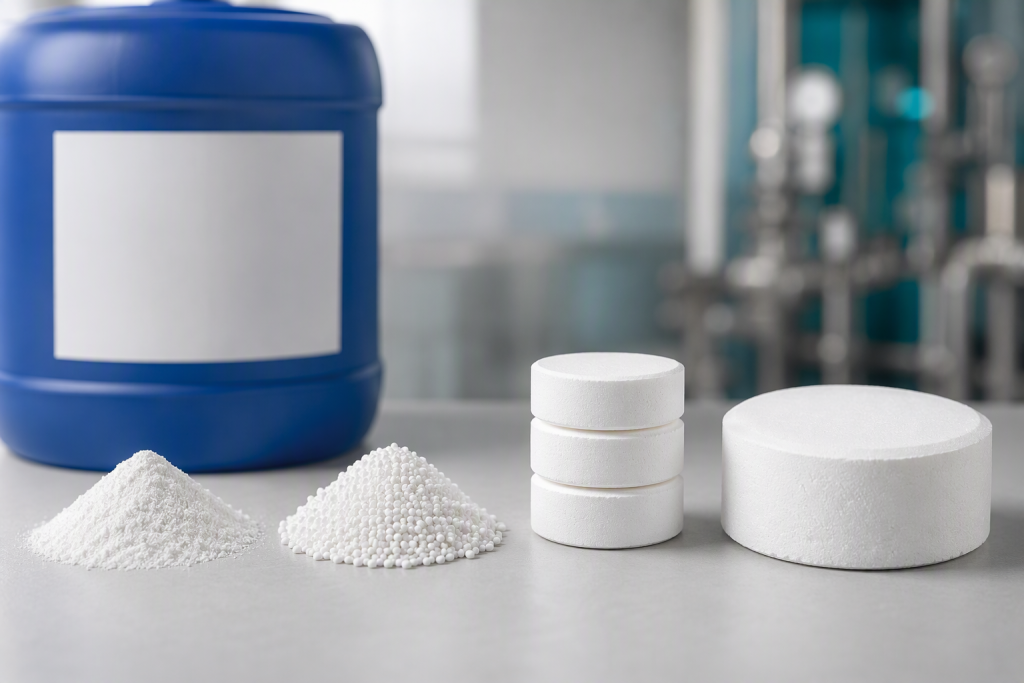
TCCA is supplied in three forms. Unlike SDIC, where powder is the volume leader, tablets are the dominant TCCA format globally, followed by granular, then powder.
2.1 Powder
Standard specification is 200 mesh. Powder is rarely the end product; it is bought as a raw material for downstream formulation — compounding into blended sanitisers, cleaning products, or as feedstock for a tablet press. Industrial sterilisation applications that need immediate full dispersion also use powder.
2.2 Granular
Standard specification is 8-30 mesh. This is the general-purpose slow-dissolve granule used across pools and cooling towers. It suits erosion feeders and automatic dosing equipment where a controlled dissolution rate matters but tablet handling is impractical.
2.3 Tablet — the TCCA mainstream
Tablets split into three functional families, and choosing between them is the single most consequential specification decision:
| Tablet Family | Weights | Behaviour | Application |
|---|---|---|---|
| Fast-dissolve | 1 g / 2 g / 10 g | Rapid release | Rapid disinfection scenarios, point-of-use treatment |
| Slow-release | 20 g / 50 g / 200 g / 250 g | Extended controlled release | Swimming pools and landscape water — the core commercial specification |
| Large chlorine cake | 1 kg / 2 kg | Very long duration | Industrial cooling towers, large water bodies |
The 200 g slow-release tablet is the global reference product for commercial pool maintenance, delivering roughly 7-10 days of controlled dissolution per tablet in a standard floating dispenser.
3. Decision Three — Mesh Size (Granular Buyers)
Mesh determines dissolution rate, dosing uniformity and equipment compatibility. TCCA granular is standardised at 8-30 mesh for pool and cooling tower use. For comparison, SDIC offers a wider granular ladder because its application range is broader:
| Mesh Range | Particle Character | Where It Is Used |
|---|---|---|
| 8-30 mesh | Large granule, slow dissolve | Pools, industrial recirculating water |
| 20-40 mesh | Medium granule | Aquaculture water body broadcasting (SDIC mainstream) |
| 20-60 mesh | Fine granule, uniform dissolution | General disinfection applications |
| 200 mesh | Powder | Formulation feedstock, immediate dispersion |
| 325 mesh | Ultra-fine powder | Blending applications requiring maximum surface area |
Practical rule: larger mesh number means finer particle and faster dissolution. If you are feeding an erosion chlorinator, specify 8-30 mesh. If you are broadcasting across a pond surface, 20-40 mesh gives better distribution before the granules sink.
4. Decision Four — Product Grade Classification
Beyond chemical specification, TCCA is classified by intended application, and this classification drives which certifications you need:
| Classification | Market Position | Certification Implication |
|---|---|---|
| Industrial grade | General industrial water treatment | ISO 9001, MSDS, COA baseline |
| Pool grade | Largest volume segment globally | NSF/ANSI 50 for North American commercial pools |
| Drinking water grade | Municipal and potable supply | NSF/ANSI 60 mandatory in many US states |
SDIC carries a wider classification set including food grade and disinfectant grade (the latter requiring medical or public-health channel licensing in China). TCCA’s narrower classification reflects its concentration — at 90% available chlorine it is generally too aggressive for direct food-contact and emergency drinking water applications, which is precisely where SDIC holds exclusive territory.
5. Packaging Specification
| Package | Specification | Notes |
|---|---|---|
| Plastic drum | 25 kg | Mainstream bulk packaging; superior moisture barrier |
| Woven bag | 25 kg | Lower cost, requires dry warehouse conditions |
| Jumbo bag | 1000 kg | Large-volume industrial supply |
| Small drum | 1 kg / 5 kg | Retail and small-batch customers |
Note the difference from SDIC, where woven bags with double PE inner liner are the bulk mainstream. TCCA leans toward plastic drums as the primary bulk format specifically because moisture protection is more critical — higher available chlorine means faster degradation on moisture ingress.
6. Matching Specification to Buyer Type
Different buyer segments converge on predictable specifications. If your specification does not match your segment, you are either overpaying or under-serving:
| Buyer Segment | Preferred Specification | Primary Concern |
|---|---|---|
| Pool chemical distributor | 200 g slow-release tablet, 90% | Chlorine stability and seasonal delivery reliability |
| Water treatment contractor | Granular 8-30 mesh, 90-92% | Compliance documentation and heavy metals reporting |
| OEM brand purchaser | Tablets, custom size and branding | Private-label capability and regulatory paperwork |
| Textile / paper industrial buyer | Jumbo bag bulk, 90% | Bulk pricing versus liquid chlorine alternatives |
| Government / NGO procurement | Standardised drum packaging | WHO quality standard alignment |
7. Specification Errors That Cost Money
- Ordering 92% for a pool floater. You pay a purity premium and get faster dissolution than the application wants. Specify the 88-90% slow-release grade instead.
- Ordering powder when you need granular. Powder in an erosion feeder produces a slug dose then nothing. Feeders need 8-30 mesh granules or tablets.
- Ordering woven bag for humid destinations. Southeast Asian and tropical warehousing needs sealed plastic drums. Woven bags in high humidity produce caking and chlorine loss.
- Specifying TCCA for food-contact sanitation. At 90% available chlorine, TCCA is generally unsuitable; food processing equipment sanitation is SDIC territory.
- Accepting a quote without confirming grade. A supplier quoting unusually low prices may be supplying 88% product labelled as 90%. Always require a third-party COA from SGS, BV or TUV before final payment.
8. Frequently Asked Questions
What is the difference between TCCA 90% and TCCA 92%?
Both are trichloroisocyanuric acid. The 90% grade is the standard industrial specification used across pools and general water treatment. The 92% premium grade has tighter impurity control and suits high-end export orders and drinking water applications where low-impurity certification is required. The 92% grade carries a per-tonne price premium.
Why is slow-release TCCA only 88-90% instead of 90%+?
Slow-release formulations include binder and formulation components that optimise dissolution rate. These displace a small amount of active chlorine, which is a deliberate engineering trade-off — you gain extended controlled release at the cost of two percentage points of concentration.
Which TCCA form should I buy for a commercial swimming pool?
The 200 g slow-release tablet is the global reference specification, delivering roughly 7-10 days of controlled dissolution per tablet in a floating dispenser or skimmer basket. For automated erosion feeders, 8-30 mesh granular is the alternative.
What mesh size should I specify for granular TCCA?
8-30 mesh is the standard TCCA granular specification for pools and cooling towers. Larger mesh numbers indicate finer particles and faster dissolution; if you need faster action, 20-60 mesh is available but is more commonly an SDIC specification.
Can TCCA be used for drinking water treatment?
Drinking-water-grade TCCA exists and is used in municipal treatment where locally approved. However, SDIC generally dominates potable and emergency water treatment because its lower concentration and faster dissolution produce lower residual concerns. Verify local regulatory approval before commercial supply.
What is the minimum order quantity for custom tablet specifications?
Standard sizes ship at 1 MT for LCL trial orders. Custom tablet dimensions, weights and formulations typically require higher volumes because tooling and production line changeover carry setup cost. Discuss specific requirements with the technical team.
Related Reading
- TCCA 90% Complete Product Specification Guide
- SDIC vs TCCA: Which Chlorine Disinfectant Should You Buy?
- TCCA Export Markets and Certification Roadmap 2026
- Chlorine Pricing Breakdown: FOB China 2026
Need help matching a specification to your application, or a sample of a specific grade and mesh? Contact the Shilan Chemical technical team — we respond within 24 hours with COA documentation.