Last updated: July 2026 · Reading time: 8 min
SDIC is one of the most widely used chlorine disinfectants, but “widely used” does not mean “handle without care”. This safety guide covers OSHA exposure limits, LD50 toxicity data, PPE requirements, first aid procedures, and MSDS compliance for workers and safety officers managing Sodium Dichloroisocyanurate in commercial or industrial settings.
1. What Is SDIC and Why Safety Matters
Sodium Dichloroisocyanurate (CAS 2893-78-9) is a solid organic chlorine compound that releases hypochlorous acid (HOCl) when dissolved in water. It is safer than gaseous chlorine or liquid bleach for transport and storage but still classified as:
- UN 2465 Class 5.1 Oxidizer, Packing Group II/III
- GHS Category 3 Acute Oral Toxicity
- GHS Category 2 Skin Irritant and Eye Damage
- GHS Category 3 Specific Target Organ Toxicity (respiratory)
2. OSHA Exposure Limits
OSHA has not published a substance-specific PEL for SDIC as of 2026, but relevant limits apply to its hydrolysis products:
| Substance | OSHA PEL (8-hr TWA) | ACGIH TLV (8-hr TWA) | NIOSH IDLH |
|---|---|---|---|
| Chlorine (Cl2) | 1 ppm ceiling | 0.5 ppm TWA / 1 ppm STEL | 10 ppm |
| Chlorine Dioxide (ClO2) | 0.1 ppm | 0.1 ppm TWA / 0.3 ppm STEL | 5 ppm |
| Hypochlorous Acid mist | Not established | Not established | – |
| Cyanuric Acid dust | Not established | 10 mg/m³ TWA (as total dust) | – |
Reference: OSHA Occupational Chemical Database.
3. Toxicity – LD50 and Health Effects
- Oral LD50 (rat): 1,671 mg/kg body weight – low acute toxicity
- Dermal LD50 (rabbit): more than 2,000 mg/kg – low absorption toxicity
- Inhalation LC50 (rat, 4-hr): more than 5.0 mg/L (dust)
Acute effects from typical workplace exposure:
- Eye contact: severe irritation, corneal damage risk at higher concentration
- Skin contact: irritation, chemical burn possible on prolonged contact
- Inhalation of dust: nose, throat, and lung irritation; can trigger chemical pneumonitis at high exposure
- Ingestion: gastrointestinal irritation, vomiting, systemic hypochlorite effects
4. Required Personal Protective Equipment (PPE)
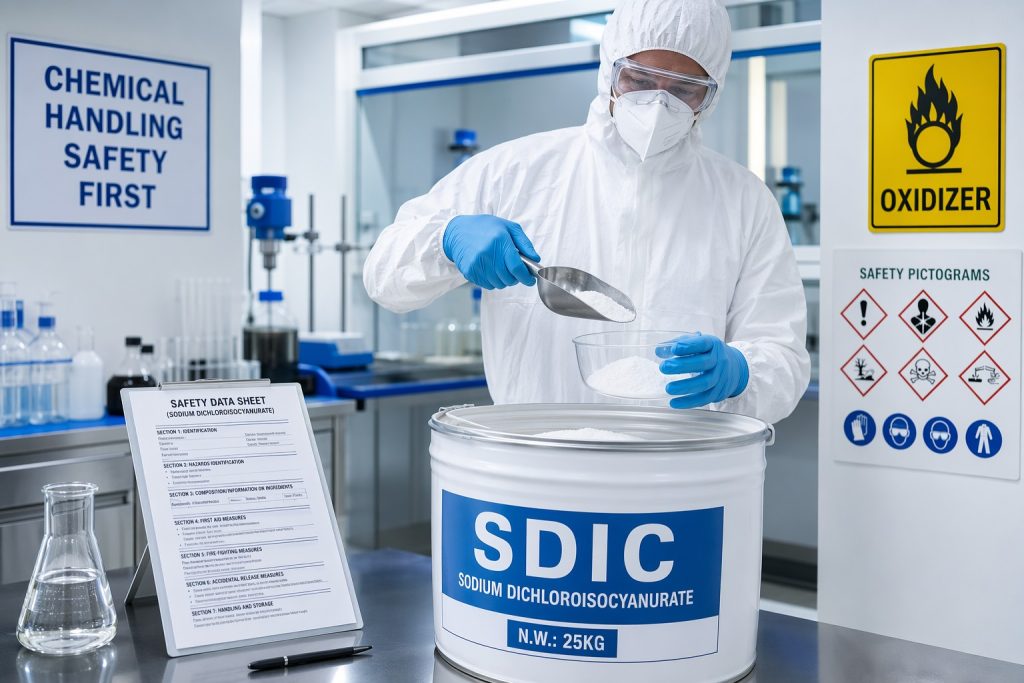
Standard Handling (weighing, dosing, tablet packaging)
- Chemical splash goggles (ANSI Z87.1) – safety glasses alone are insufficient
- Chemical-resistant gloves – nitrile 8+ mil or neoprene
- N95 respirator minimum for dust; P100 preferred in confined spaces
- Chemical apron and closed-toe boots
- Long sleeves and long pants; no exposed skin
Emergency Cleanup or Large Spills
- Full-face air-purifying respirator with acid gas and P100 cartridge
- Chemical-resistant Tyvek F suit or equivalent
- Butyl rubber gloves and boots
- SCBA (Self-Contained Breathing Apparatus) if concentration is unknown
5. Safe Handling Procedures
- Never mix SDIC with acids, ammonia, ammonium salts, or organic materials. These reactions release chlorine gas or toxic chloramines.
- Add SDIC to water; never add water to SDIC. Reverse order can cause a localized exothermic reaction.
- Use dedicated stainless steel or plastic scoops – never brass or aluminum, which can catalyze decomposition.
- Keep containers closed except during use. SDIC absorbs moisture from air and can slowly decompose, releasing chlorine.
- Provide local exhaust ventilation at weighing and mixing stations. General room ventilation is not enough.
6. Storage Requirements
- Temperature: below 30 degrees C (86 F) ideal; must stay below 60 C to prevent thermal decomposition
- Humidity: keep below 65% relative humidity to avoid caking and hydrolysis
- Segregation: minimum 6 meters from oxidizers (nitrates, peroxides), acids, and organic materials
- Fire code: classified as NFPA Class 3 oxidizer; storage rooms require automatic sprinklers and fire suppression per NFPA 400
- Container integrity: HDPE drums with sealed liners; inspect monthly for corrosion or moisture ingress
7. First Aid Procedures
Eye Contact
Immediately flush with clean water for at least 15 minutes, lifting eyelids. Get emergency medical attention. Do not attempt to neutralize with any solution.
Skin Contact
Remove contaminated clothing. Wash exposed area with soap and water for 15 minutes. Get medical attention if irritation or burn develops.
Inhalation
Move victim to fresh air immediately. If breathing is difficult, administer oxygen. If not breathing, provide artificial respiration. Get emergency medical attention.
Ingestion
Rinse mouth with water. Do not induce vomiting – risk of chlorine gas release in airway. Have victim drink 1-2 glasses of water or milk. Get emergency medical attention immediately.
8. Emergency Response – Spills and Leaks
Small Spill (less than 5 kg)
- Evacuate area, don PPE
- Sweep up dry material with plastic broom into a clean plastic container
- Do not use wet cleanup – creates chlorine solution and vapor
- Ventilate area for at least 1 hour
Large Spill (more than 5 kg or fire involvement)
- Evacuate 25-50 meter radius; alert facility emergency team
- Call CHEMTREC 1-800-424-9300 (US) or local hazmat response
- Do not use water on dry spill – reaction generates chlorine gas
- For fire involvement, use dry chemical or CO2. If water is required, use flooding amounts from safe distance
9. MSDS/SDS Requirements
Every SDIC container must be shipped with a current SDS in the destination country language. The SDS must follow GHS 16-section format:
- Identification (product name, supplier, emergency contact)
- Hazard identification (GHS classification, pictograms)
- Composition (chemical name, CAS, purity %)
- First aid measures
- Fire fighting measures
- Accidental release measures
- Handling and storage
- Exposure controls and PPE
- Physical and chemical properties
- Stability and reactivity
- Toxicological information
- Ecological information
- Disposal considerations
- Transport information
- Regulatory information
- Other information (revision date, disclaimer)
10. Training and Documentation
OSHA Hazard Communication Standard (29 CFR 1910.1200) requires:
- Initial training before first exposure
- Annual refresher training documented in employee file
- Access to SDS 24/7 (paper or electronic)
- Container labeling in English (and Spanish if 5+ Spanish-speaking employees)
- Written HazCom program on-site
11. FAQ – SDIC Safety
Is SDIC safe for skin contact in low concentrations?
Diluted SDIC solution (e.g., 200 ppm sanitizing solution) is not intended for skin contact but rinses off without harm. Concentrated powder or solution above 5,000 ppm can cause chemical burns within minutes.
Can I use SDIC and bleach together?
No. Both release chlorine species; mixing produces higher chlorine gas concentration in air. Also unnecessary – SDIC provides equivalent disinfection independently.
Does SDIC produce chloramines like pool chlorine?
Yes, when SDIC solution contacts ammonia or organic nitrogen (urine, sweat), chloramines form. Chloramines cause eye irritation and the classic “chlorine smell” at pools. Prevention: shower before swimming, adequate water turnover.
Related reading:
For MSDS/SDS in your local language or a factory safety audit report, contact Shilan Chemical technical team.