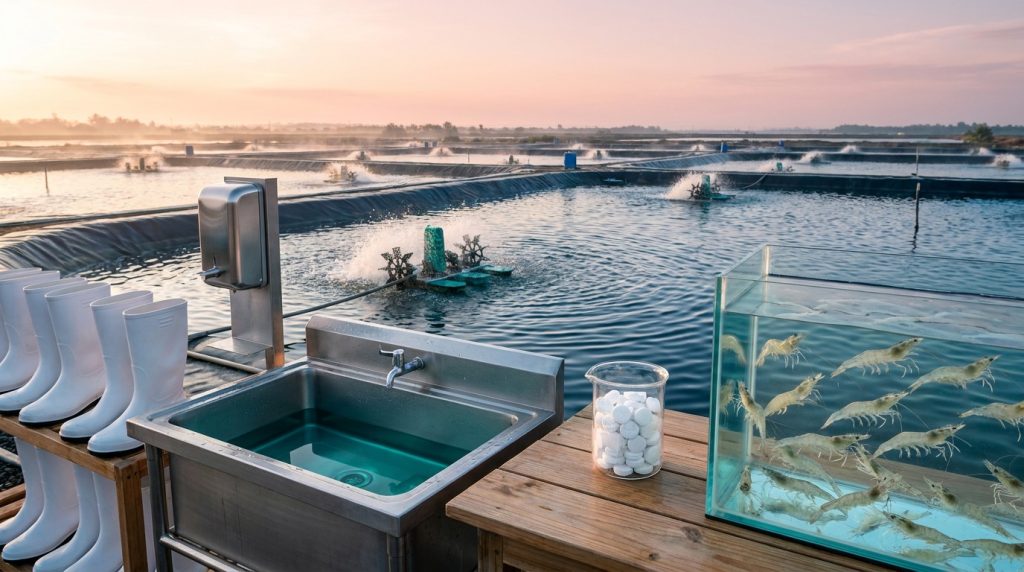
Quick answer: To prevent White Spot Syndrome Virus (WSSV) and Vibrio bacterial infections, implement a four-stage SDIC biosecurity protocol: (1) 50 ppm SDIC pre-stocking pond sterilization with 72-hour retention, (2) 100 ppm SDIC footbath at all farm entry points refreshed daily, (3) 200–400 ppm SDIC equipment immersion disinfection between batches, and (4) 0.5 ppm SDIC weekly grow-out treatment with continuous aeration. Combined with PCR screening of post-larvae and biofloc management, this protocol reduces WSSV outbreak rates by up to 80% based on field data from Southeast Asian shrimp farms.
White Spot Syndrome Virus (WSSV) and Vibrio parahaemolyticus (causing Early Mortality Syndrome / EMS) together cause over USD 6 billion in annual losses to global shrimp aquaculture. Chemical disinfection with Sodium Dichloroisocyanurate (SDIC) is the cornerstone of any effective biosecurity program. This guide consolidates field-tested protocols from Shilan Chemical‘s customers operating shrimp farms in Vietnam, India, Ecuador, Indonesia, and Thailand.
Understanding the Two Major Shrimp Pathogens
White Spot Syndrome Virus (WSSV)
- Pathogen type: DNA virus (family Nimaviridae)
- Mortality rate: 90–100% within 3–7 days of clinical onset
- Affected species: Pacific white shrimp, black tiger shrimp, crayfish
- Transmission: Water-borne, carrier crustaceans, contaminated equipment
- SDIC inactivation threshold: 5 ppm free chlorine, 30-minute contact
Vibrio parahaemolyticus (EMS/AHPND)
- Pathogen type: Gram-negative bacterium
- Mortality rate: 70–100% within 20–30 days of stocking
- Affected species: Primarily Pacific white shrimp
- Transmission: Sediment, biofilm, carrier shrimp post-larvae
- SDIC inactivation threshold: 1 ppm free chlorine, 15-minute contact
The 4-Stage SDIC Biosecurity Protocol
Stage 1: Pre-Stocking Pond Sterilization
The single most important step. Performed once at start of each grow-out cycle on completely drained ponds.
- Dose: 50 ppm SDIC 60% (50 kg per 1,000 m³)
- Procedure: Re-flood empty pond to 30 cm depth, broadcast pre-dissolved SDIC, hold 72 hours
- Target organisms killed: WSSV, EHP (microsporidia), Vibrio, hydra, crab carriers, snail intermediate hosts
- Critical: Test free chlorine = 0 before stocking PL; if residual remains, add sodium thiosulfate at 1:0.5 ratio
Stage 2: Personnel and Vehicle Footbaths
Front-line defense against farm-to-farm transmission. WSSV is highly stable on contaminated boots and tires.
- Dose: 100 ppm SDIC solution (1 kg SDIC 60% in 6,000 L water = ~1.7g per 10L)
- Locations: Every farm entry point, between pond clusters, lab and feed room thresholds
- Refresh: Daily, or immediately after visible contamination
- Contact time: Boots and wheels submerged minimum 60 seconds
Stage 3: Equipment Immersion Disinfection
Nets, sample buckets, aerator parts, harvest tools — all major outbreak vectors if reused without proper cleaning.
- Dose: 200 ppm SDIC for routine equipment, 400 ppm for known-contaminated tools
- Procedure: Soak 30 minutes, rinse with clean water, dry in sunlight
- Frequency: Daily for shared equipment, between batches for dedicated equipment
Stage 4: In-Pond Routine Prophylaxis
Maintains low-level antimicrobial pressure without disrupting beneficial pond ecology.
- Dose: 0.5 ppm SDIC 60% weekly (or 1 ppm bi-weekly for higher-risk seasons)
- Timing: Early morning, immediately after partial water exchange
- Aeration: Run all aerators at maximum for 6 hours post-dosing
- Pause if mortality observed: >0.5% daily mortality requires immediate diagnostic workup before next SDIC application
Field-Validated Outbreak Recovery Protocol
When clinical signs appear (WSSV: white spots on carapace + lethargy; Vibrio: empty gut + red gill + mass mortality), follow this 5-step recovery procedure:
- Stop feeding immediately — reduces metabolic load on stressed shrimp
- Increase aeration to 100% capacity — affected shrimp have compromised oxygen uptake
- Apply 5 ppm SDIC shock dose — kills free-swimming pathogen in water column (note: this is a salvage operation, not a guaranteed cure)
- Partial water exchange (30–40%) after 24 hours — removes dead biomass and pathogen load
- If mortality continues >20%, emergency harvest — salvage value of survivors and prevent catastrophic loss
Comparison: SDIC vs Other Aquaculture Disinfectants
| Disinfectant | Effective Against | Pond Safety | Cost / 1,000 m³ (USD) | Best Use Case |
|---|---|---|---|---|
| SDIC 60% | WSSV, Vibrio, EHP, fungi | High (pH neutral) | 4–6 | All-purpose, recommended |
| Calcium hypochlorite | Most pathogens | Medium (raises pH) | 3–5 | Pre-stocking only |
| Formalin | External parasites | Low (carcinogenic) | 8–15 | Rarely; being phased out |
| Iodine compounds | Bacteria and viruses | High | 20–40 | Egg disinfection only |
| Potassium permanganate | External bacteria | Low (toxic if overdosed) | 10–15 | Emergency only |
Real Field Outcomes from SDIC-Based Programs
Anonymized data from Shilan Chemical customer farms running the 4-stage protocol for 18 months:
- WSSV outbreak rate: dropped from 18% of cycles to 4%
- EMS/AHPND incidence: dropped from 12% to 3%
- Average survival rate: increased from 62% to 81%
- Average harvest weight: improved by 12% due to better water quality
- Disinfection cost per cycle: USD 380–520 per hectare (small fraction of saved revenue)
Common Misconceptions That Defeat Biosecurity
“Disinfection kills all my probiotics, so I won’t use it”
Re-inoculate probiotics 48 hours after SDIC treatment. The pathogen reduction far outweighs probiotic loss.
“SDIC is too expensive for routine use”
At ~USD 5 per 1,000 m³ for 1 ppm dosing, weekly treatment costs less than 1% of feed cost — and prevents disasters worth 100× more.
“My pond is small, I don’t need biosecurity”
Smaller ponds face higher relative biosecurity risk because of denser stocking and shared water sources.
“SDIC will affect my organic certification”
SDIC residues are undetectable within 24 hours and are permitted under most organic aquaculture standards (e.g., EU 2018/848 for pre-stocking use).
FAQ
How fast does SDIC kill WSSV in pond water?
At 5 ppm free chlorine, WSSV is inactivated within 30 minutes at typical pond temperatures (28–30°C). Lower temperatures require longer contact time.
Can I use SDIC during shrimp molting?
Use the lowest effective dose (0.5 ppm) and skip if >30% of population is observed molting. Newly molted shrimp are extra sensitive.
Does SDIC work in salt water as well as fresh?
Yes, equally effective in salinities up to 35 ppt. Slightly higher doses (1.2×) recommended above 30 ppt salinity.
How do I store SDIC at a humid coastal farm?
Use original sealed HDPE drums in a ventilated room below 30°C. Avoid direct contact with steel surfaces. Even with humidity, properly stored SDIC retains potency for 24 months.
Ready to Implement a Biosecurity Program?
Shilan Chemical supplies aquaculture-grade SDIC 60% (Veterinary GMP certified) with technical support tailored to your pond layout, target species, and regional regulations. Free 500g sample plus customized biosecurity protocol available for serious enquiries. Connect with our aquaculture team for an initial consultation.