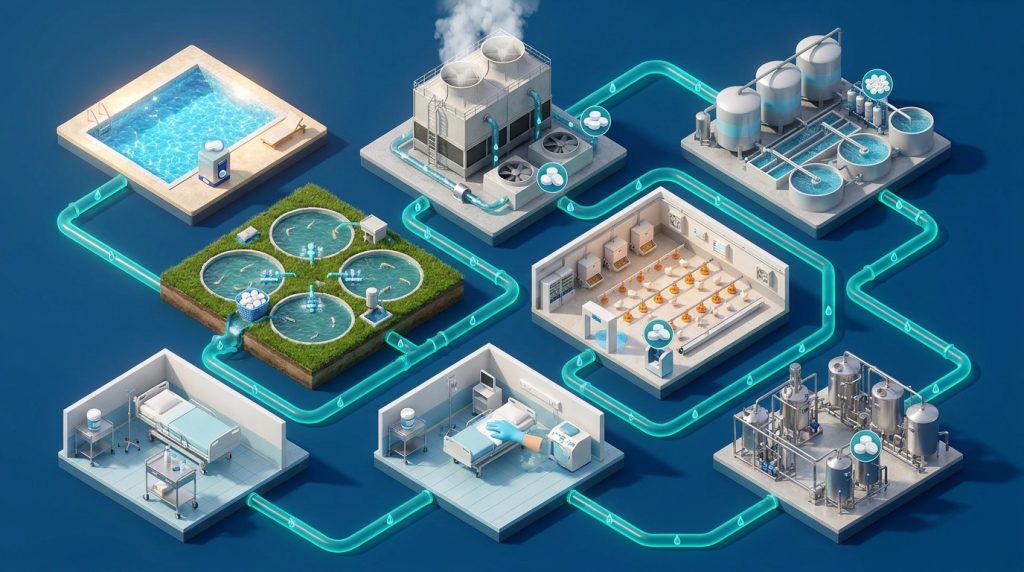
Quick answer: The 7 largest industries using TCCA in 2026 are: (1) swimming pool sanitation, (2) industrial cooling water, (3) drinking water treatment, (4) aquaculture and fish farming, (5) livestock biosecurity, (6) hospital and clinical disinfection, and (7) food processing CIP systems. Combined, these sectors consume approximately 1.2 million tons of TCCA per year globally.
Trichloroisocyanuric Acid (TCCA), with 90% available chlorine, is the most concentrated stabilized chlorine donor on the global market. This article breaks down each major industrial application with specific use cases, typical dosing ranges, and market intelligence for sourcing professionals.
1. Swimming Pool Sanitation (~38% of global TCCA demand)
The largest single application. Residential pools, hotel resorts, water parks, and Olympic facilities all rely on TCCA 200g multi-functional tablets for sustained chlorination.
- Typical dose: 2 g/m³ daily, 10 g/m³ for shock
- Preferred form: 200g slow-release tablets
- Market drivers: Tourism recovery post-2024, expanding hotel pipelines in Southeast Asia and the Middle East
2. Industrial Cooling Water Treatment (~22%)
Cooling towers in power plants, data centers, petrochemical refineries, and HVAC systems use TCCA to control biofilm, Legionella, and microbial slime that reduce heat-exchange efficiency.
- Typical dose: 5–10 ppm continuous, 50 ppm slug dose weekly
- Preferred form: Granular (8–30 mesh) for automated chlorinators
- Compliance: Required by OSHA, WHO, and most regional cooling tower regulations
3. Municipal & Emergency Drinking Water (~14%)
Emergency water purification (disaster relief, military field operations, remote villages) and small-scale municipal systems use TCCA tablets for safe potable water.
- Typical dose: 0.5–2 ppm residual after 30-min contact time
- Preferred form: 8mm or 20g tablets for portability
- Standards: NSF/ANSI 60 certified or equivalent
4. Aquaculture and Fish Farming (~10%)
Shrimp ponds, tilapia farms, and prawn hatcheries across Southeast Asia, Latin America, and Africa use TCCA to control vibrio, white-spot virus, and other pathogens.
- Typical dose: 0.5–1 ppm prophylactic; 5–10 ppm for outbreak response
- Preferred form: Powder for rapid dispersion across large ponds
- Note: Must comply with FDA / EU food residue limits before harvest
5. Livestock & Veterinary Biosecurity (~7%)
Poultry farms, cattle dairies, and pig operations use Veterinary GMP-grade TCCA for barn floor disinfection, footbaths, and watering line sanitization.
- Typical dose: 200–400 ppm surface spray
- Preferred form: Effervescent tablets for footbaths
- Requirement: Veterinary GMP certification mandatory in most markets
6. Hospital and Clinical Disinfection (~5%)
Hospitals, dental clinics, and laboratories use TCCA effervescent tablets to prepare on-demand disinfecting solutions for floor cleaning, equipment sanitization, and infectious waste handling.
- Typical dose: 500–1000 ppm for blood spills, 200 ppm for general surfaces
- Preferred form: 2.5g or 5g tablets in blister packs
- Demand spike: Post-pandemic standardization of infection control protocols
7. Food Processing CIP/COP Systems (~4%)
Dairies, beverage bottling plants, and meat processors use TCCA in Clean-In-Place (CIP) systems for stainless steel tank, pipe, and conveyor sanitization between production runs.
- Typical dose: 100–200 ppm contact, 5–10 min dwell time
- Preferred form: Granular for automated CIP dosing pumps
- Compliance: FDA 21 CFR 178.1010 or equivalent
Market Outlook for TCCA Distributors
The global TCCA market is projected to grow at 4.8% CAGR through 2030, driven primarily by aquaculture expansion in Vietnam, India, and Ecuador, plus accelerating pool construction in the GCC region.
Where to Buy Bulk TCCA?
Shilan Chemical produces TCCA 90% in multiple forms — tablets (200g/100g/20g), granular (5–8 / 8–30 mesh), and powder — with annual capacity of 15,000 tons. Every shipment is SGS-tested. Request a quote for FOB or CIF pricing to your port.