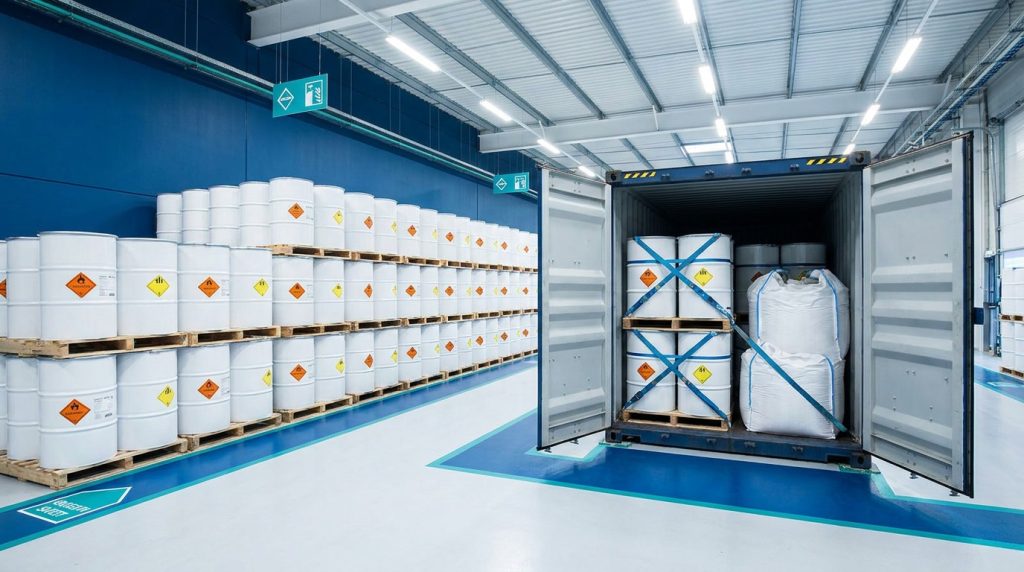
Quick answer: TCCA is classified as UN 2468, Hazard Class 5.1 (oxidizer); SDIC is UN 3077, Hazard Class 9 (miscellaneous). Both must be stored below 30°C in dry, ventilated warehouses, away from acids, ammonia, oils, and reducing agents. Maritime shipping requires IMDG-certified packaging and segregation per Code 5.1 / Code 9 stowage rules.
Mishandling chlorinated isocyanurates is a leading cause of warehouse fires and shipping incidents in the chemicals trade. This guide compiles the storage and transport requirements every TCCA/SDIC buyer, distributor, and warehouse manager must follow.
Hazard Classification Quick Reference
| Property | TCCA (Trichloroisocyanuric Acid) | SDIC (Sodium Dichloroisocyanurate) |
|---|---|---|
| UN Number | UN 2468 | UN 3077 |
| Hazard Class | 5.1 (Oxidizing Substance) | 9 (Miscellaneous Dangerous Goods) |
| Packing Group | II | III |
| Marine Pollutant | No | No |
| IMDG Stowage | Category A (on deck or under deck) | Category A (on deck or under deck) |
| Maximum Storage Temp | 30°C / 86°F | 30°C / 86°F |
Warehouse Storage Requirements
Temperature and Humidity
- Maximum temperature: 30°C (86°F). Above this, chlorine release accelerates and product degrades.
- Relative humidity: Below 60%. Moisture absorption causes caking and slow chlorine loss.
- Direct sunlight: Strictly prohibited. UV exposure triggers premature decomposition.
Incompatible Materials (Strictly Separate)
Never store TCCA or SDIC near:
- Ammonia or ammonium compounds: Releases toxic nitrogen trichloride gas
- Strong acids (HCl, H₂SO₄): Generates chlorine gas instantly
- Organic materials (oils, paper, sawdust): Fire hazard
- Reducing agents (sulfur, hydrazine): Violent exothermic reaction
- Other chlorine donors (calcium hypochlorite): Cross-contamination causes auto-ignition
Ventilation
Maintain at least 6 air changes per hour. Install chlorine gas detectors (alarm threshold: 0.5 ppm). Provide emergency exhaust capable of clearing the warehouse within 5 minutes.
Maritime Shipping Requirements
Approved Packaging
- Inner packaging: Sealed HDPE bags or PE-lined drums
- Outer packaging: UN-certified fiber drums, plastic drums (50kg), or IBC totes (1000kg) bearing the proper UN marking
- Labeling: Hazard class diamond label (5.1 for TCCA, 9 for SDIC), proper shipping name, UN number, packing group, and emergency contact
Container Loading
- Use only dedicated dry containers, never reefer or food-grade
- Place desiccant bags throughout the container (minimum 2 kg per 20′ container)
- Inspect for prior contamination — never load into a container previously used for oils or ammonia products
- Block and brace pallets to prevent shifting during voyage
Documentation
Every international shipment requires:
- Material Safety Data Sheet (MSDS) — both UN and country-specific format
- Certificate of Analysis (COA) — batch-specific, signed by QC manager
- Dangerous Goods Declaration (DGD) per IMDG Code
- Container Packing Certificate
- Insurance certificate covering hazardous cargo
Spill and Fire Response
Spill Procedure
- Evacuate the area; only personnel in full PPE (respirator, gloves, goggles) may enter
- Sweep up dry product with non-sparking tools; do NOT use water on dry spill
- Place into a clean, dry, labeled container
- Decontaminate the area with diluted sodium thiosulfate solution
Fire Procedure
- Use ONLY copious amounts of water — do NOT use foam, CO₂, or dry chemical (these worsen the situation)
- Cool surrounding containers from a safe distance with water spray
- Evacuate downwind area to a 500-meter radius due to chlorine gas release
- Notify local emergency services immediately and provide MSDS
Country-Specific Import Requirements
United States
EPA registration required for any chlorine donor marketed for pool/spa use. Distributors must hold a current EPA Establishment Number.
European Union
REACH registration mandatory. Active substance approval under BPR (Biocidal Products Regulation) required for biocidal applications.
Southeast Asia (ASEAN)
Most ASEAN countries accept SGS or BV inspection reports. Vietnam, Thailand, and Indonesia require additional product registration for aquaculture use.
Middle East (GCC)
GCC Standardization Organization (GSO) certification needed for consumer-facing products. Industrial bulk supply typically requires only standard MSDS.
Why Choose a Compliant Supplier?
Shilan Chemical’s TCCA and SDIC products ship with full IMDG-compliant packaging, UN-certified drums, batch COAs, and country-specific MSDS variants. Every container is loaded under QC supervision with desiccant and bracing. Contact us for a compliance pre-check before placing your first order.